The logo design industry is booming. You’ll see countless designers, agencies, and freelancers pop up when you search for them online. You’ll also come across extraordinary promises made by every other source.
With multiple service providers and clickbaiting content, selecting a reliable and professional one is harder than ever. Especially when you’ve recently launched a new business or are revamping an older one, you don’t want to create the wrong impression or waste your money.
So, what do you do in that scenario? Well, scrutinize logo design services by asking the right questions!
Let’s walk through five key questions you should ask any prospective designer or agency before handing over your project.
Here are the five questions that every business owner should ask when reaching out to logo design companies, and tips for how to interpret the answers:
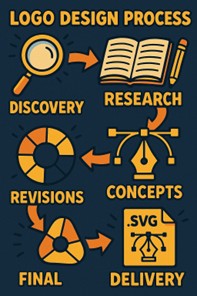
A logo isn’t something you just hand off and forget. A well-structured process ensures that the designer or agency understands your goals, does research, explores options, iterates, refines, and finalizes in a controlled, timely way. If the provider cannot clearly explain their process, it’s a red flag. They may rush, cut corners, or skip important steps.
A portfolio just with final logos is fine, but seeing full project case studies (sketches, alternatives, grid systems, mockups) reveals how in-depth the designer works. Many companies claim logo design best practices, but don’t have any work to back up the claim.
When reviewing a design portfolio, look for variety and depth. A designer won’t have all logos or projects looking the same in style, color palette, and concept, which shows flexibility. Check whether each example includes details like the client brief, challenges faced, research insights, concept evolution, final design, and real-world implementation.
Strong portfolios also display designs in mockups, such as signage, app icons, or stationery, to show practical application. If available, review measurable results such as increased sales, brand recognition, or engagement. These success metrics reflect the designer’s ability to create visuals that perform.
Once a logo is done, you’ll need it in many forms: vector files, high-resolution raster, black and white, various aspect ratios, scalable for signage, web, print, etc. Also, legal clarity about ownership and usage rights is vital. You don’t want to be surprised later (e.g., you can’t use the logo on merchandise, or the designer still retains control).
Design is iterative. Sometimes your first reaction to a concept will not be good, and you’ll want to shift direction. You need a process that allows back-and-forth, but also protects both sides from scope creep. Clear expectations on communication style, feedback rounds, turnarounds, and approvals matter a lot.
You want a balance: flexibility to adjust, but control so the project doesn’t drag on forever.
This is about avoiding nasty surprises. Some designers quote a business logo design price but charge extra for color versions, mockups, or brand guidelines. Others may request half payment up front, others full, or milestone payments. You want clarity.
You want to avoid being nickel-and-dimed after approving a final logo.
| # | Question | Why It Matters | What to Listen to or Look For |
|---|---|---|---|
| 1 | What’s your process and timeline? | You want clarity, not surprises. | Do they do research, sketches, and revisions? Are milestones set? |
| 2 | Can I see real examples/a portfolio that includes the full project process? | You need confidence that they can deliver what you want. | Do they show before/after, alternate concepts, rationale? |
| 3 | What deliverables/formats and rights will I get? | You need usable files and legal clarity. | Will they deliver vector, SVG, color versions, black/white, and social sizes? Are all rights transferred? |
| 4 | How will we collaborate, and how many revisions are included? | You want smooth, controlled changes without unexpected fees. | Check their revision policy, communication method, and approvals. |
| 5 | What are the costs and payment terms, and what’s excluded? | You want to avoid hidden costs. | Be sure of what’s in scope (brand guide? usage rights? stationery?), when you pay, refund, or cancellation policy. |
When evaluating a logo design service (freelancer, boutique, or agency), here’s how to use the five questions:
Ask questions 1 and 5 early (process, timeline, rough cost). If their answers are vague or evasive, they’re not a reliable choice.
For those who pass the first stage, dive into question 2. Request case studies, detailed past work, and even examples of concepts that didn’t make the final cut.
Use questions 3–5 to check deliverables, formats, usage rights, revisions, and payment terms before signing anything.
Compare your options not only by price, but by process clarity, communication style, and overall trust level.
Once you select a provider, prepare a clear brief, sign a contract, and stay involved throughout the process — without micromanaging.
Just to help you picture it, here’s a fictional but plausible scenario of working with a solid logo design service:
Your first meeting, whether on Zoom or in person, sets the foundation. The designer learns about your business goals, audience, competitors, and current branding. They’ll ask questions about colors, taglines, values, and vision to ensure the logo captures your brand’s personality and purpose from the very beginning.
Next comes a detailed proposal outlining the process, timeline, deliverables, and payment terms. It ensures transparency on what you’ll get and when. The contract also clarifies ownership rights, revisions, and communication flow so both sides understand expectations before any design work officially begins.
This phase is where strategy meets creativity. The designer studies your competitors, builds mood boards, and explores color psychology. They may conduct audience surveys or interviews. By analyzing what works in your industry and what doesn’t, they gather insight that guides stronger, more intentional logo concepts.
You’ll receive three distinct logo directions, often starting as black-and-white sketches before color is introduced. Each concept shows a unique visual story for your brand. The goal isn’t just to look good; it’s to present different ways your identity could connect with your audience authentically.
Now it’s your turn to react. You’ll choose your favorite direction (or mix elements from several). The designer then refines, tweaks, and polishes over two or three feedback rounds. This back-and-forth ensures your logo feels right, communicates clearly, and reflects your business identity perfectly.
Once approved, you receive all necessary file formats—vector, raster, color, mono, and icon versions—plus real-world mockups. A usage guide is also provided, explaining color codes, clear space, and size rules. Everything is packaged neatly so you can confidently apply your logo anywhere.
Some designers offer continued support after launch. They might help you integrate your new logo across digital and print assets—like websites, signage, packaging, and business cards. A little guidance at this stage ensures your brand rollout looks cohesive and professional everywhere it appears.
Choosing a logo design service isn’t just about getting something that looks good. It’s about finding a creative partner who listens, researches, and builds your visual identity with purpose. A great designer doesn’t just deliver files; they hand you a foundation from which your entire brand can grow.
Go for expertise, not shortcuts. The right logo feels effortless, but behind it are layers of thought, testing, and refinement. So, ask questions. Ask again if something feels unclear. A true professional will never shy away from explaining their process, because they know what you’re buying isn’t just a symbol. It’s your first impression, your voice, and your story made visible.
Looking for more information? Call us at +1 (855) 521-5040 for quick support!


Have a project in mind? Reach out to us, and we’ll help turn your ideas into stunning illustrations.
Tell us what you need, and we’ll create a custom illustration just for you. Reach out today and let's get started!
 +1 (855) 521-5040

Copyright © 2026 360 Illustration House | All rights reserved. Terms And Conditions | Privacy Policy | Refund Policy


 LIVE CHAT
 +1 (855) 521-5040